Full Coverage vs Liability Insurance: When Should You Downgrade Your Policy in 2026?

Every six months, a bill arrives in your mailbox or inbox that likely makes you cringe. It is your auto insurance renewal. As rates across the United States continue to climb in 2026, many drivers are looking for ways to cut costs. The quickest way to slash your premium is to change your coverage type.
The most common debate is between full coverage car insurance and basic liability. One offers total peace of mind while the other keeps you legal for the lowest possible price. Making the wrong choice can be financially devastating. If you drop coverage too soon, a single accident could bankrupt you. If you keep it too long, you are throwing money away. In this guide, we will break down the math behind these policies and help you decide exactly when it is safe to downgrade.
What is Liability Insurance?
Liability insurance is the foundation of any auto policy. In almost every state, it is mandatory.
What It Covers
Liability coverage pays for the damage you cause to other people. It does not pay a single cent to fix your own car.
- Bodily Injury Liability: Pays for the medical bills of the person you hit.
- Property Damage Liability: Pays to repair the other driver’s car or any property you destroyed, such as a fence or street sign.
Who It Is For
Liability-only policies are designed for drivers with older vehicles that have little cash value. It protects your assets (like your house and savings) from lawsuits, but it leaves your vehicle completely unprotected.
What is Full Coverage?
“Full coverage” is actually a marketing term. It is not a specific line item on your policy. Instead, it typically refers to a combination of Liability plus Collision and Comprehensive coverage.
Collision Coverage
This pays to repair your own vehicle if you hit another car or an object like a tree. It applies regardless of who was at fault. If you accidentally back into a pole, collision coverage pays to fix your bumper, minus your deductible.
Comprehensive Coverage
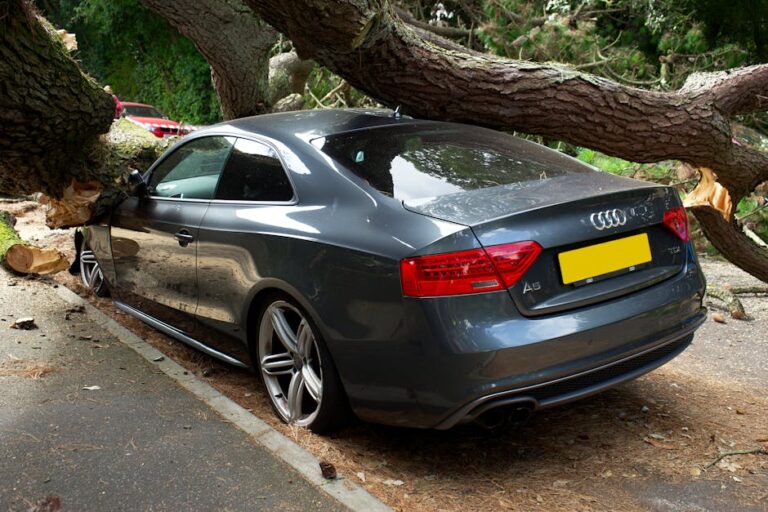
This pays for damage that is not caused by a crash. This includes theft, vandalism, fire, hail damage, and hitting an animal like a deer. If a tree branch falls on your hood during a storm, comprehensive coverage picks up the bill.
The Cost Difference
The price gap between these two options is significant. In 2026, the national average for full coverage car insurance is approximately $2,300 per year. The average for liability-only is around $700 per year.
That is a difference of $1,600 annually. For many families, that savings is enough to pay for a vacation or cover a month of mortgage payments. However, saving that money shifts the risk entirely onto your shoulders.
The “10 Percent Rule” for Downgrading
So, when does it make sense to switch? Financial experts often cite the “10 Percent Rule.”
You should consider dropping full coverage car insurance when the annual cost of the premium plus your deductible exceeds 10 percent of your car’s cash value.
Let Us Do the Math
Imagine you drive a 2014 Honda Civic.
- Car Value: $5,000
- Annual Cost for Full Coverage: $1,200
- Deductible: $500
- Total Cost of Potential Claim: $1,700
In this scenario, you are paying $1,200 a year to protect an asset worth $5,000. If you total the car, the insurance company will give you $5,000 minus your $500 deductible. That is a payout of $4,500. You paid $1,200 to protect a potential $4,500 payout. That is a poor return on investment. It is time to switch to liability.
A Different Scenario
Now imagine you drive a 2023 Toyota RAV4.
- Car Value: $28,000
- Annual Cost for Full Coverage: $1,800
- Deductible: $500
Here, paying $1,800 to protect a $28,000 asset makes total sense. If you totaled this car without insurance, you would lose nearly $30,000. Keep the full coverage.
When You MUST Have Full Coverage
There are situations where you do not have a choice.
1. You Have a Loan or Lease
If you financed your car, the bank technically owns it until you make the final payment. The lender will require you to carry full coverage car insurance to protect their collateral. If you let it lapse, they will add “force-placed insurance” to your loan, which is incredibly expensive.
2. You Cannot Afford to Replace Your Car
Ask yourself a simple question. If your car was stolen tomorrow, could you afford to buy a replacement with cash from your savings account? If the answer is “no,” you need full coverage. Insurance is a tool to transfer risk. If you cannot handle the financial risk of replacing your vehicle, you must pay the insurance company to handle it for you.
How to Lower Full Coverage Costs
If you need full coverage but hate the price, there are ways to lower the premium without dropping the protection entirely.
Raise Your Deductible
The collision deductible is the amount you pay out of pocket before insurance kicks in. Most drivers have a $500 deductible. If you raise this to $1,000 or $2,000, your monthly premium will drop significantly.
This strategy works if you have an emergency fund. You are betting that you will not crash. If you stay accident-free for three years, the savings on premiums will likely exceed the higher deductible you would pay in the event of a claim.
Drop Car Rental and Roadside Add-ons
Check your policy for “extras.” Do you really need rental car reimbursement coverage? If you have a second car in the household, you can drop this. Do you have AAA? Then drop the towing coverage from your insurer. Removing these small line items adds up.
The Danger of Being Underinsured
While saving money is great, being underinsured is dangerous.
State minimum liability limits are often laughably low. For example, in California, the minimum property damage liability is only $5,000. If you crash into a Tesla or a Mercedes, $5,000 will not even cover the cost of a new bumper and headlights. You will be sued for the difference.
Even if you choose a liability-only policy, ensure your liability limits are high enough. Experts recommend at least 100/300/100 coverage ($100k per person, $300k per accident, $100k property damage). The difference in price between state minimums and higher limits is usually just a few dollars a month.
Conclusion
The decision to switch from full coverage car insurance to liability is a mathematical one. It is not about how good of a driver you are. It is about asset value.
Check your car’s current value on Kelley Blue Book today. Compare it to your annual insurance premium. If your car is worth less than $4,000 or if the premiums are eating up more than 10 percent of the car’s value, it is time to downgrade.
However, if you drive a modern vehicle that would be impossible for you to replace with cash, keep the full protection. Shop around for better auto insurance quotes or raise your deductible, but do not leave yourself exposed to a financial disaster just to save a few dollars a month.